
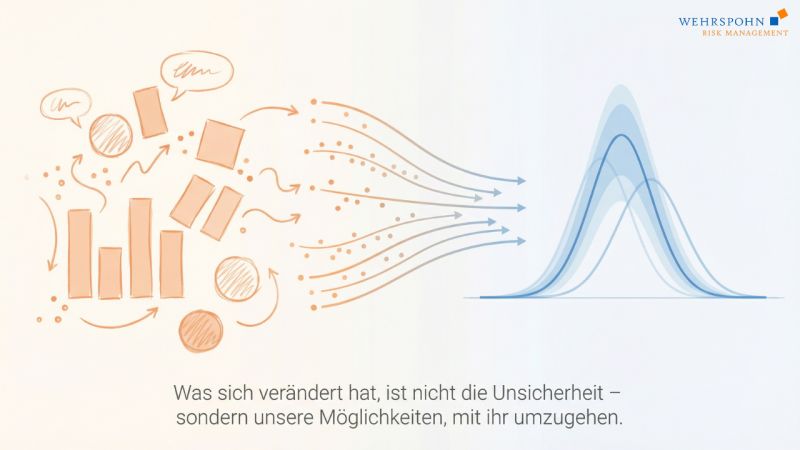
What are the best pieces of information we can deliver today with reasonable effort? The widespread use of expert assessments in risk management is historically well founded. Decisions under uncertainty require expectations, and for many decades, the judgments of experienced people were often the best available information that could be obtained with reasonable effort. A look back makes this clear. When Hans-Werner Sinn, for instance, wrote his doctoral thesis on decisions under uncertainty in the late 1970s, companies had neither powerful computers nor integrated data sets nor practical simulation methods available. Under those conditions, it was rational to assess risks primarily on an expert basis. Today the conditions are fundamentally different. Computing power, data availability, and methodological tools have developed to an extent that was hardly conceivable a few decades ago. This also shifts a central question in risk management: not whether expert assessments are permissible, but what today counts as the best information that can be produced with reasonable effort. If a company today, despite these possibilities, cannot deliver more far-reaching, consistent, and updatable risk statements, it may be worth taking a look at its methods, processes, and tools, not as criticism, but as a perspective for further development. In our experience, this is exactly where value is created: through procedures that structure existing knowledge, make uncertainty transparent, and prepare decisions better, without unnecessary complexity. With our products, we support companies in taking this step in a pragmatic and connectable way.
This post was originally published on LinkedIn. View and join the discussion there