
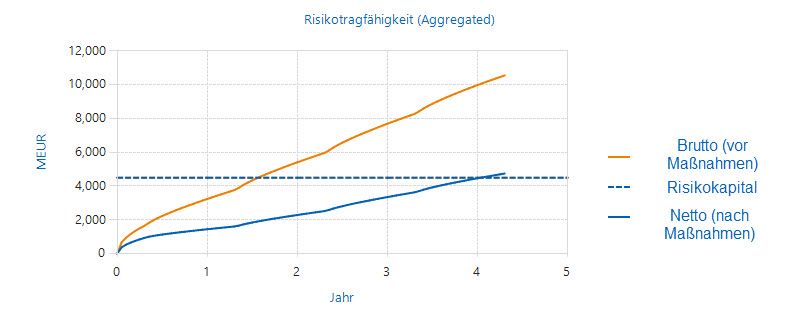
In the short term, every company has risk-bearing capacity Risk-bearing capacity is usually discussed as a question of money. You look at a fixed time horizon, typically one year, and check whether the risk capital exceeds the risks over that period. If so, risk-bearing capacity is considered satisfied. What this analysis leaves out, however, is that risks scale over time while risk capital, conversely, erodes over time. So in a prolonged crisis in a country with many frictions, does a company have enough time to reduce risks through further measures or to raise new capital? As the time horizon shortens, risks approach zero, and much faster than linearly. In the short term, every company therefore has risk-bearing capacity. But how long can a company get by on its existing risk capital, and how much room to maneuver, in time and in money, does it gain through risk management and good risk-mitigating measures? The chart shows a company's risk capital requirement as a function of the risk horizon into the future, once without measures (orange) and once with measures (blue), compared with the available risk capital. On paper, the company has risk-bearing capacity even without risk management. Through risk management, however, it saves large amounts of capital and gains 2.5 years of room to maneuver in time, exactly when it needs it.
This post was originally published on LinkedIn. View and join the discussion there