
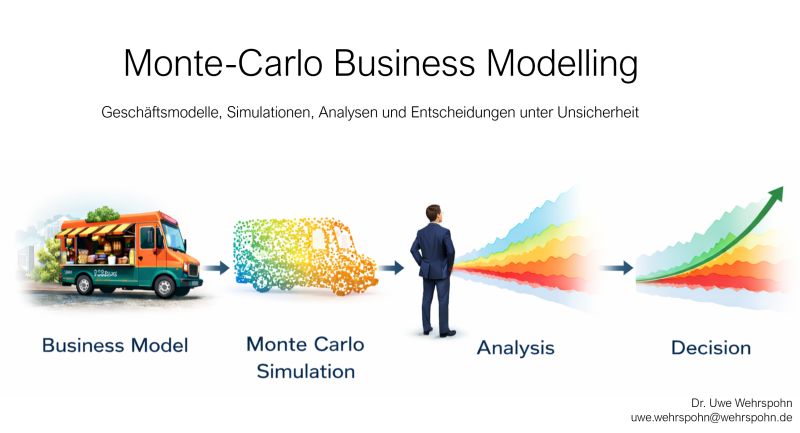
Today I am starting the lecture course “Monte Carlo Business Modelling” at the Dresden University of Applied Sciences (HTW Dresden). Together with the students, we develop a business model step by step, from the first vision to a stable business process. We start with the fundamental building blocks of a company: • products • production • employees • customers • resources • environment and market Building on that, we systematically refine the model: • value propositions • key partners, key activities, and key resources • customer segments, customer relationships, and sales channels • cost structure and revenue streams From these elements, we build a digital twin of the business model. We analyze this model using Monte Carlo methods: • explicit modeling of all assumptions • description of dependencies between the factors • simulation of the central value and risk drivers This produces a quantitative picture of key questions: • What really drives the company's value? • Where are the biggest risks? • How robust is the business model under different scenarios? We simulate the development of the company across different phases, from founding through growth phases to establishment as a stable company. The simulations can be run in real time and ultimately result in a presentation and a final report, just as investors or boards need them for their decisions. I am very much looking forward to the lecture course and to working with the students on these business models.
This post was originally published on LinkedIn. View and join the discussion there