
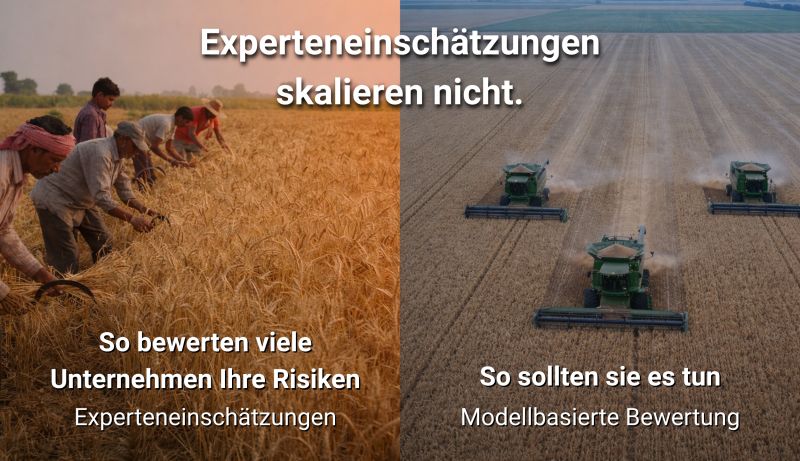
Expert assessments do not scale in any dimension Many companies still rely heavily on expert assessments in Enterprise Risk Management. The problem: This approach does not scale. And it fails to scale in several dimensions at once: 1️⃣ Number of risks Experts are a scarce resource. More risks mean more workshops, more coordination, more effort. At some point, selection happens, and risks fall through the cracks. 2️⃣ Time horizon One year? Feasible. Three years? Difficult. Five years? Speculation. The further you look into the future, the less reliable the assessment. 3️⃣ Complexity In practice, simplification is inevitable. Often, one and the same methodology is applied to all risks: the same distributions, the same logic. The individual structure of a risk gets lost in the process. 4️⃣ Update frequency Assessments are rarely updated: quarterly, semi-annually, or annually. And, to be honest: In many cases, 90% are simply confirmed as is. 5️⃣ Scenario capability “What happens in the stress scenario?” The honest answer: In most cases this is not calculated but discussed, because it is too costly to have experts reassess every assumption each time. The alternative: model-based risk assessment Models follow a different scaling principle. The effort is at the beginning, in developing the model. Once the model is built, you have a system that scales almost arbitrarily. And suddenly the rules of the game change: ✔️ Whether 100 or 30,000 risks are assessed no longer matters ✔️ Whether you look at one year or ten years follows the same logic ✔️ Updates can be run at any time, even daily ✔️ Scenario analyses are not discussed, but calculated ✔️ Complexity is not reduced, but represented in a structured way ✔️ Aggregation happens consistently and in a mathematically sound way The decisive point: Expert assessments are a linear system. More requirements automatically mean more effort. Models are a nonlinear system. More requirements barely lead to additional effort. What does this mean for companies? Not “expert or model.” But rather: 👉 Experts are used for structuring and building the model 👉 Models take over the scalable assessment Whoever continues to rely exclusively on expert assessments is implicitly choosing a system with a built-in growth limit. And that is exactly what becomes a problem in modern risk management.
This post was originally published on LinkedIn. View and join the discussion there