
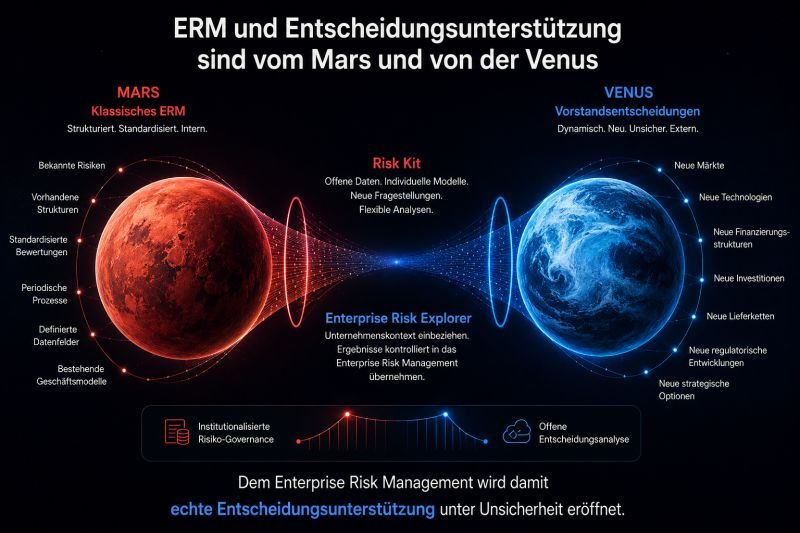
ERM and decision support are from Mars and from Venus There is currently a lot of discussion about how Enterprise Risk Management needs to be integrated more strongly into management decisions. The fundamental problem here is often underestimated. ERM works with: • known risks • existing structures • standardized assessment logic • periodic processes • fixed, predefined data fields • existing organizational and business models Board decisions, on the other hand, often revolve around entirely new questions: • new markets • new technologies • new financing structures • new investments • new supply chains • new regulatory developments • new strategic options For these, classic ERM often has neither the required data nor the necessary models. One example: How should a new plant be structurally financed? For that, you need, among other things: • interest rate developments • alternative financing structures • cash flow models • debt scenarios • market assumptions • interactions with existing obligations This information is typically not available within Enterprise Risk Management. ERM was never designed for questions like this in the first place. That is why it is not enough to “integrate ERM more strongly into decisions.” If risk management is to provide genuine decision support, it must be opened up technically and methodologically: • to heterogeneous data • to individual models • to new target variables • to long-term analyses • to flexible scenarios • to questions outside standardized processes This is exactly where Risk Kit and the Enterprise Risk Explorer close the gap. With Risk Kit, open data streams, individual models, and new questions can be flexibly processed and analyzed, even when no structure yet exists within classic ERM for the specific decision at hand. The Enterprise Risk Explorer makes it possible to factor in the company's context and then transfer the relevant results into Enterprise Risk Management in a controlled, traceable way. This creates a bridge between: • open decision analysis and • institutionalized risk governance This opens up genuine decision support under uncertainty for Enterprise Risk Management.
This post was originally published on LinkedIn. View and join the discussion there