
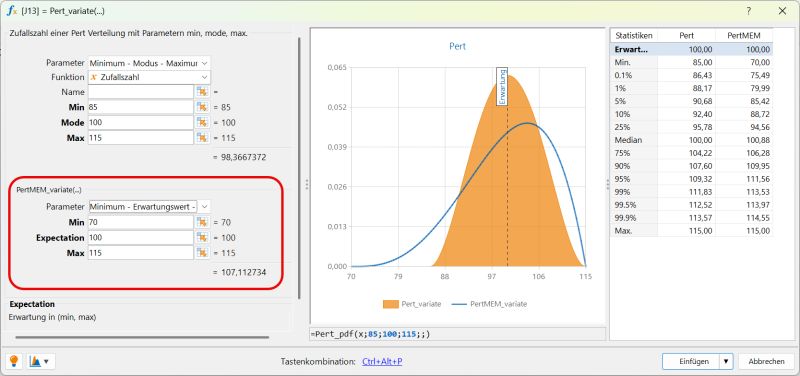
“Our planning is unbiased.” And then you build in an asymmetric PERT distribution … → and suddenly the expected value no longer matches. This is a topic I currently see very often. Many people rightly want to achieve two things at once: • a realistic representation of risk (including a stronger downside) • and still an unbiased plan (plan value = expected value) The problem: As soon as you simply “pull down” a PERT distribution (e.g., by reducing the minimum or the most likely value), 👉 the expected value automatically drops as well. And with that, the plan is no longer unbiased, often without anyone even noticing. But there are two completely different objectives: 1. Deliberately plan more conservatively → the expected value is meant to be below the plan value ✔ then shifting downward is correct ✔ typical for scenario analyses (“What if we are too optimistic?”) 2. Stay unbiased, but represent the downside more realistically → and this is exactly where it gets interesting Then you need to proceed differently: • create more room on the downside (push the minimum further down) • at the same time adjust the most likely value • so that the expected value stays stable This seems counterintuitive at first, but it is exactly the clean way to do it. In practice, this often fails because of the parametrization. Because the classic PERT works with: • minimum • mode (most likely value) • maximum 👉 and not with the expected value. The simple solution: work directly with the expected value. This is exactly why Risk Kit has the PertMEM parametrization: • minimum • expected value • maximum The rest is calculated consistently in the background. This has two decisive advantages: ✔ The plan value is guaranteed to remain the expected value ✔ Asymmetries can be built in deliberately (e.g., more downside) My impression from many projects: The real problem is not the choice of distribution, but the lack of control over the expected value. And that is exactly where biases quietly creep in. So the crucial question is not only: “Which distribution do we use?” but: 👉 “Does our model actually stay unbiased, despite all the risk logic?” How do you handle this in your models?
This post was originally published on LinkedIn. View and join the discussion there