
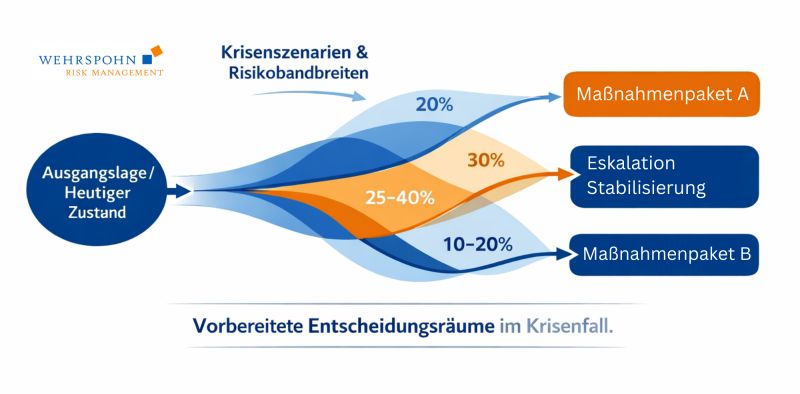
How risk modeling concretely supports resilience and crisis management. Resilience and crisis managers face the task of staying able to act under high uncertainty in turbulent developments and of grounding decisions in a robust way. Quantitative risk modeling offers a structured approach for this that does not aim at prediction but systematically supports the ability to decide. A central contribution of risk models is making critical risk drivers visible. By explicitly modeling influencing factors, dependencies, and interactions, it becomes transparent which quantities actually shape a system's resilience and where targeted measures can be applied. This transparency is an important foundation for prevention, precaution, and prioritization. Risk models enable consistent work with scenarios. A system's resilience only becomes apparent in exceptional situations. Model-based scenarios allow different crisis trajectories to be played out systematically, assumptions to be varied in a targeted way, and alternative courses of action to be compared with one another. This creates a robust basis for decisions under time pressure, especially for crisis managers. Impacts and ranges are explicitly determined as results. Instead of single point values, risk models deliver distributions, ranges, and probabilities. This makes visible what impact can realistically be expected, how large the uncertainties are, and which measures can have which effects. This supports an objective prioritization of measures and resources, both in preparation and during an acute crisis. Decisions can be prepared even before a crisis occurs. Escalation paths, response options, and packages of measures can be analyzed and assessed in the model in advance. When an event occurs, resilience and crisis managers then draw on prepared decision spaces instead of having to develop ad hoc solutions under time pressure. Finally, quantitative risk models create a high degree of compatibility with steering, communication, and governance. They provide a shared, traceable basis for decisions for management, crisis teams, and business units, and make it easier to communicate risks, courses of action, and consequences. Risk modeling is thus a tool with which resilience and crisis managers can systematically strengthen the ability to act, transparency, and decision quality.
This post was originally published on LinkedIn. View and join the discussion there