
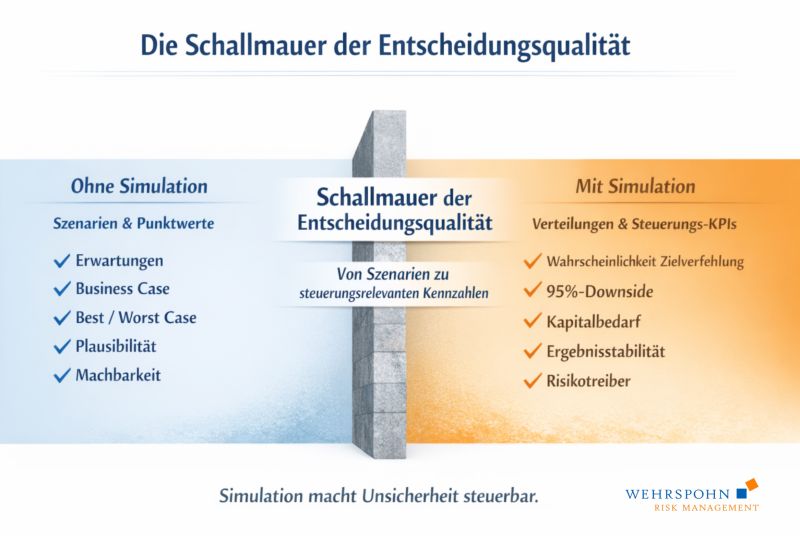
🚀 How to break through the sound barrier of decision quality. Many decisions in companies are made under uncertainty, without quantitative models and without simulation. And that works up to a certain point. Then you hit a sound barrier. 🟦 Without quantitative models, decision makers typically ask: • What revenue or result do we expect? • What does the business case look like? • What happens in the best case? • What happens in the worst case? • Which option seems more plausible? • Does the project feel feasible? These are legitimate questions, but they only deliver point values and scenarios. They offer few starting points for targeted improvement or steering. You see extremes, but you get no continuous feedback that would let you optimize decisions step by step. 🟥 From here on, you cannot go further without simulation. At the latest, other questions now appear: • How likely is it that we miss our target? • How large is our loss in the 95% case? • How often do we realistically post a loss? • How much capital do we need to stay reliably solvent? • How stable is the result under small changes in the assumptions? • Which risks reinforce each other? • Which variables drive the bulk of our overall risk? These are no longer scenario questions but steering-relevant metrics. And that is exactly what simulation is needed for. 🔄 The real paradigm shift The difference is not “more mathematics.” The difference is: 👉 These questions become KPIs. 👉 You get feedback on decisions. 👉 You can change decisions in a targeted way. For example: We reduce the probability of losses. We lower the 95% downside. We stay within our risk-bearing capacity. We make the result more robust. Suddenly you can optimize decisions iteratively instead of fixing them once and hoping. 🧩 Second key effect: assumptions become visible Without models, assumptions stay implicit. With models, they are there in black and white: • Sales ranges • Cost variability • Project durations • Correlations And this is exactly what creates enormous quality: 👉 Illusory assumptions stand out immediately. 👉 Discussions become concrete. 👉 Wrong decisions are recognized earlier. Because simulation requires assumptions to become explicit. And that requires a platform. You need an environment in which: • assumptions are captured in a structured way • uncertainties are modeled • local simulation is possible • results are prepared in a decision-relevant way That is exactly why we developed Risk Kit and the Enterprise Risk Evaluator. Not as calculation tools, but as decision platforms for uncertainty. 💡 In short: Without quantitative models, you make decisions. With quantitative models, you can steer and improve decisions in a targeted way. And that is the actual sound barrier.
This post was originally published on LinkedIn. View and join the discussion there