
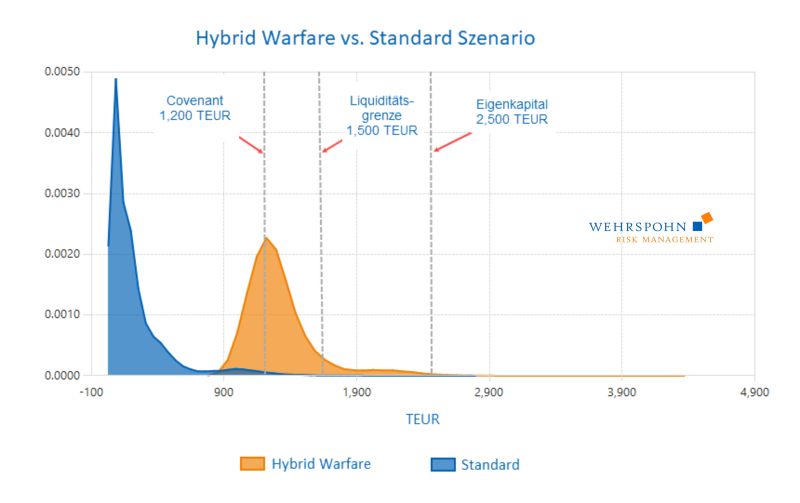
When “hybrid warfare” becomes reality, it is not just a single event for companies. It is a complex stress scenario: cyberattacks, disinformation, supply chain disruptions, politically motivated interventions, and economic pressure, all in parallel and interconnected. That is why it is worth analyzing the scenario of such a state of emergency before it occurs. First, you need to define what the scenario actually consists of: Which attacks run simultaneously? What dynamics and sequence over time are plausible? What intensity and duration are assumed? The second step concerns exposure: Which areas would be directly affected? Are these effects already covered in the risk inventory? Or does the scenario reveal dimensions that have not been monitored so far? First result: blind spots become visible. Then comes the structural check: interactions, dependencies, escalation chains. Hybrid scenarios do not act additively, they reinforce each other. Can core activities continue if several disruptions occur simultaneously? Which dependencies are critical: IT, service providers, payment transactions, staff? Where do cascades arise? Second result: systemic vulnerability becomes visible. Quantitative simulation turns this into a robust basis for decisions. The central question is: what is the aggregated effect of all the parallel attacks? Not viewed in isolation, cyberattack, supply chain failure, reputational damage, but together and simultaneously, including all interactions and second-round effects. The simulation answers: how large is the total damage when everything comes together? This is followed by the question of resilience capacity: Can the company withstand this impact? Are equity and liquidity sufficient? Are covenants breached? Does an existential threat arise? Here, resilience is made measurable as a quantitative stress test. If a vulnerability shows up, the analysis becomes the basis for active steering: Which risk drivers dominate? Where do escalation chains arise? Which dependencies amplify the damage disproportionately? And finally: which measures actually work? Which investments significantly reduce the total impact? Where can escalation chains be broken most effectively? Which redundancies are effective and which are merely cosmetic? Which resources are needed as a buffer to compensate for failures? Only through simulation does it become visible which measures noticeably increase system stability and which have almost no influence on the overall risk. Such analyses can be evaluated in a structured way in the Enterprise Risk Explorer, as a basis for identifying vulnerabilities early on together with crisis management and business units, and for building resilience in a targeted way. This is how a geopolitical buzzword turns into a corporate steering process. Complex crises will come. The question is whether we modeled them in advance.
This post was originally published on LinkedIn. View and join the discussion there