
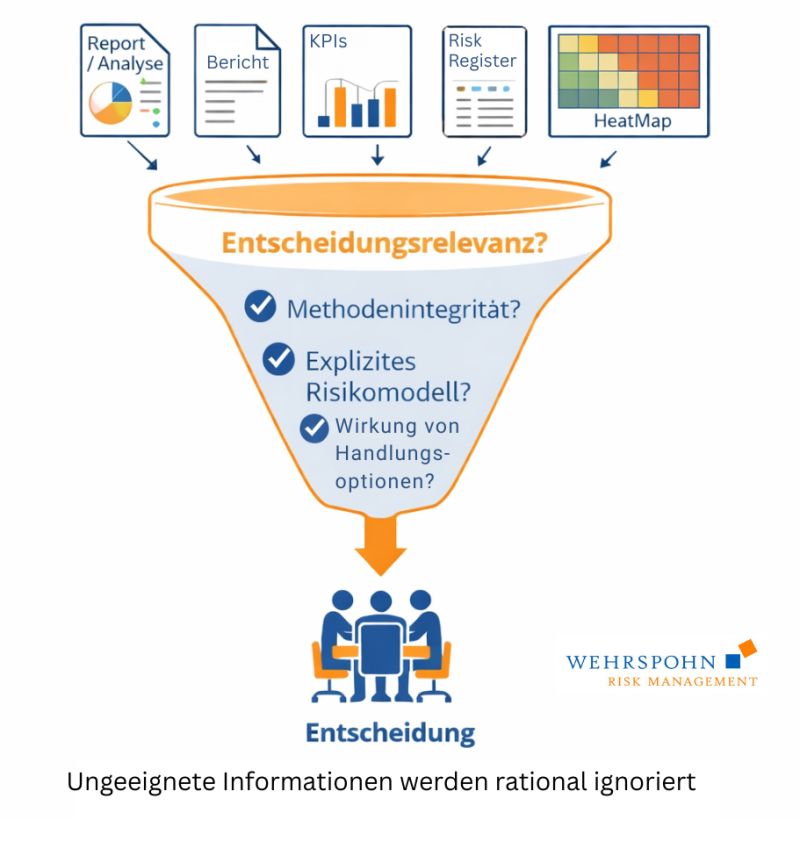
Why it can be rational not to integrate risk management into decisions In many companies, people complain that risk management is not sufficiently taken into account in decisions. This is often interpreted as a cultural problem, a lack of risk awareness, or resistance from management. Another explanation is often closer at hand, and more uncomfortable: 👉 It can be rational not to integrate risk management. Namely when it does not provide a robust basis for decisions. Decision makers do not integrate information because it was produced in a “formally correct” way, but because it helps to • assess courses of action, • compare effects, • choose timing, • and account for uncertainty in a structured way. If this quality is missing, ignoring it is not a failure, it is rational filtering. Two prior questions are decisive here: 1. Integrity of method Are methods being used that are known not to provide a consistent basis for decisions? Or are methods missing that would be necessary to properly capture uncertainty, dependencies, and effects? If the methodological basis does not hold, the result cannot hold either. 2. Model connection of options Is there an explicit causal model in which courses of action can take hold? That is, a model of risk drivers, relationships, and effects on target variables? Without such a model, options cannot be assessed, they can only be asserted. Only once these preconditions are met does it make sense to talk about decision integration, timing, or surprises. This also means: Risk management is not simply integrated into decisions. It gets integrated once it is capable of supporting decisions. That is exactly where we come in. With Risk Kit, we support companies in building explicit risk models in which courses of action, effects, and uncertainties are represented in a traceable way, as software and, where useful, accompanied by expert coaching. Not as a reporting artifact, but as a basis for decisions.
This post was originally published on LinkedIn. View and join the discussion there