
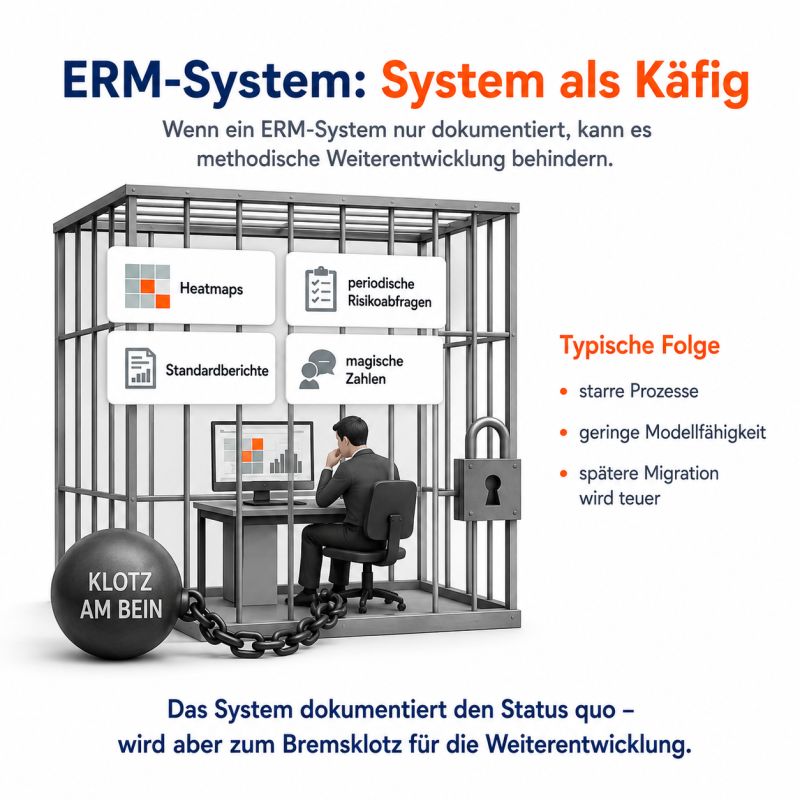
Many companies underestimate how far-reaching the decision for an enterprise risk management system actually is. It is often treated like a software selection: ◆ Which workflows are supported? ◆ What do the reports look like? ◆ Are there role and permission concepts? ◆ Can risks, actions, and controls be documented? All of that is important. But it falls short. An ERM system does not just determine how risks are documented. It also helps determine how a company's risk management can develop over the next few years. Because a system shapes: ◆ which assessment methods are practically usable ◆ which data is structured in the first place ◆ whether qualitative assessments dominate or analytical models become possible ◆ how well risk management can connect to controlling, strategy, compliance, or operational steering ◆ whether reports merely document or provide genuine decision support ◆ whether new methods such as risk models, scenario analysis, or AI can be meaningfully integrated In many cases, a company's risk management develops over the years in sync with the system's provider. If the provider stagnates methodologically, the customer's risk management stagnates too. If the system only supports periodic risk surveys, heat maps, and standard reports, it becomes very hard to later develop a decision-oriented, quantitatively robust, and adaptive risk management out of it. The problem usually does not show up in the first year after implementation. It shows up after five or ten years. By then, processes, data structures, report formats, role models, and internal routines are so deeply interwoven with the system that further methodological development is suddenly no longer just a technical question, but a migration project. That is why the choice of an ERM system should not just ask: “Can the system represent our current process?” But above all: “What kind of risk management does this system make possible in two to five years?” Because a good ERM system does not just document the status quo. It opens up development paths.
This post was originally published on LinkedIn. View and join the discussion there