
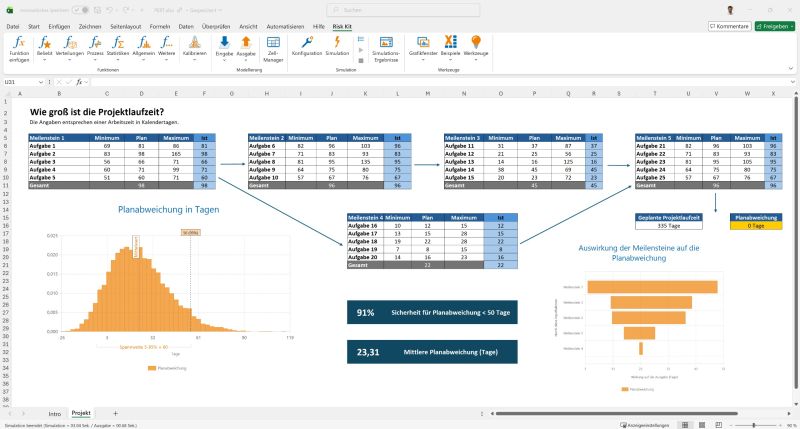
🎲 Monte Carlo simulations in project management Briefly explained: instead of assuming a fixed duration for each task in the project plan, you set ranges around the plan value: minimum duration, plan value, maximum duration. A tool combines these ranges across all the project tasks and runs the plan through a thousand times, each time with different durations. The result shows • how much schedules and costs fluctuate • with what probability project durations will be met • where the biggest plan deviations arise • which project phases are particularly critical Inspired by a LinkedIn post by Anne-Kathrin Mesch, I would like to add a point that often gets lost: There are business models where individual projects are vital to survival. Large, complex undertakings without which a company cannot survive economically, and which are at the same time so extensive that they pose a serious threat. If things go wrong, it gets really expensive. This is exactly where quantitative risk management pays off, because • deadlines • contractual penalties • liquidity • reputation all depend on it. The comments raised classic objections. They are not wrong, but they need to be seen in the right context. 🔹 “Estimates are worthless, you need historical data.” If data exists, all the better. But the claim that modeling is generally not worthwhile without a perfect history falls short. Even special projects mostly consist of activities that are already known. What is usually new is the combination. At this level, data, experience, and judgment can be combined well. 🔹 “The customer needs ONE date, not a range.” Of course they need a date. Monte Carlo shows the probability of hitting that date. And it allows for rules: we accept ✔ No completion date below 80 percent probability. ✔ No contractual penalty below 95 percent certainty. Going below that is a deliberate management decision. Especially in high-risk projects, this fundamentally changes contract negotiations. 🔹 “Too many assumptions, too complex.” You need distributions whose parameters can be justifiably set from data, experience, and expert knowledge. 🔹 “The tool doesn't matter.” When cooking, it may not matter whether you use gas or induction. But what matters is: • how long it takes me • how error-prone the process is • how well I can explain it • whether my team can manage it on their own as well The same is true for Monte Carlo. Yes, you can build all of this in R, without license costs. But with high labor costs, a lot of complexity, and results that are hardly easy to communicate. The tool determines whether simulation actually gets used. That is why we developed Risk Kit: • Monte Carlo directly in Excel • with freely selectable distributions • clear decision metrics • and results that you can explain to management, the project team, and customers. Monte Carlo is a tool for making risks visible before they materialize.
This post was originally published on LinkedIn. View and join the discussion there