
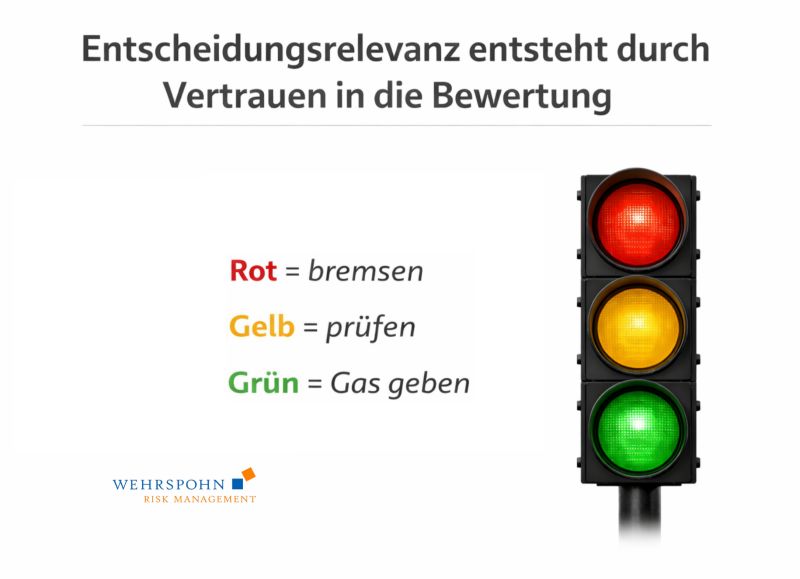
A traffic light is the simplest risk map. It is qualitative, and it is highly decision-relevant. 🚦 In the context of enterprise risk management, you keep hearing the criticism that risk maps or “risk landscapes” are an unusable form of risk communication: qualitative, colorfully painted and supposedly not decision-relevant. The opposite is true. A risk map is explicitly designed to enable decisions. And for that, it does not even have to be quantitative. It can be qualitative and still be highly decision-relevant. The best example of this is the traffic light. The traffic light is: • qualitative • extremely simple • and maximally decision-relevant Green → go Red → stop Yellow → check the situation and decide We make these decisions in split seconds, every day, millions of times. Why does that work? Not because of the colors or the qualitative representation, but because of reliability. We drive on green because we trust that a system exists in the background that guarantees cross traffic has red when we have green. 👉 Decision relevance comes from trust in the assessment, not from forgoing visualization as a risk map. What stands behind the visualization is what really matters. A qualitative representation says nothing about how a risk's position came about. In the background, calculation, simulation, and assessment can (and should) take place. The simplification is not a shortcoming, it is the decision aid. Another special feature of the traffic light: • 95% of cases are clear (green or red) and immediately decidable • 5% of cases need additional review (yellow) Good risk maps are made for exactly this distinction. If you are looking for risk management systems you can trust, ones that reliably assess complex interdependencies and make them visible in clear decision templates, 👉 then reach out to us. Our Excel toolkit “Risk Kit” and the “Enterprise Risk Evaluator” are built exactly for this: delivering decision support in complex environments and visualizing results clearly.
This post was originally published on LinkedIn. View and join the discussion there