
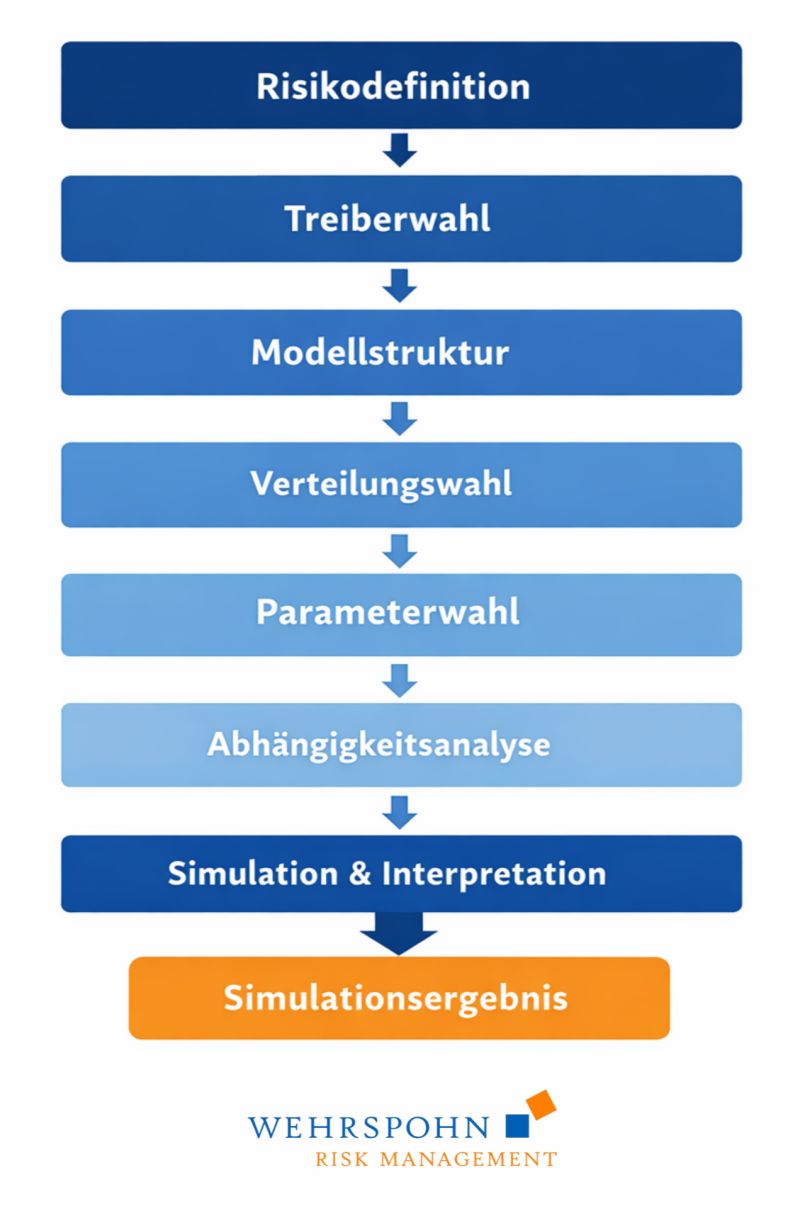
The 7 hidden decisions in every Monte Carlo simulation Many believe: “We run a Monte Carlo simulation, and the result comes out objectively.” That is a fallacy. Because before even a single simulation runs, a whole series of decisions has already been made, usually implicitly. Here are the 7 most important ones: 1. What actually is the risk? Which target variable is being modeled? Cash flow? Earnings? Liquidity? → Whatever you do not define here does not exist in the model. 2. Which drivers do we take into account? Which influencing factors go into the model and which do not? → This is often the single most important decision. 3. How are things connected? Linear? Nonlinear? Thresholds? Scenarios? → Here you determine how “the world works.” 4. Which distributions do we use? Normal distribution? Lognormal? Discrete? → This is where you decide about extreme risks, often unconsciously. 5. Which parameters do we set? Expected values, volatilities, ranges → Small changes here can have large effects. 6. Which dependencies do we assume? Independent? Correlated? Shared drivers? → This decides whether risks reinforce or offset each other. 7. How do we interpret the results? VaR? Expected value? Scenarios? → The same model can lead to completely different decisions. Conclusion: A Monte Carlo simulation is not a “calculation.” It is a chain of decisions about how uncertainty is described. And now for the uncomfortable truth: Whoever builds the model makes the decision, long before management decides. This is also why “one-click risk modeling” through AI cannot work. AI can support you. But it does not take these decisions off your hands. On the contrary: It often makes them invisible. So the real question is not: “Do we have a simulation?” But: “Have we made the right decisions within the model?”
This post was originally published on LinkedIn. View and join the discussion there