
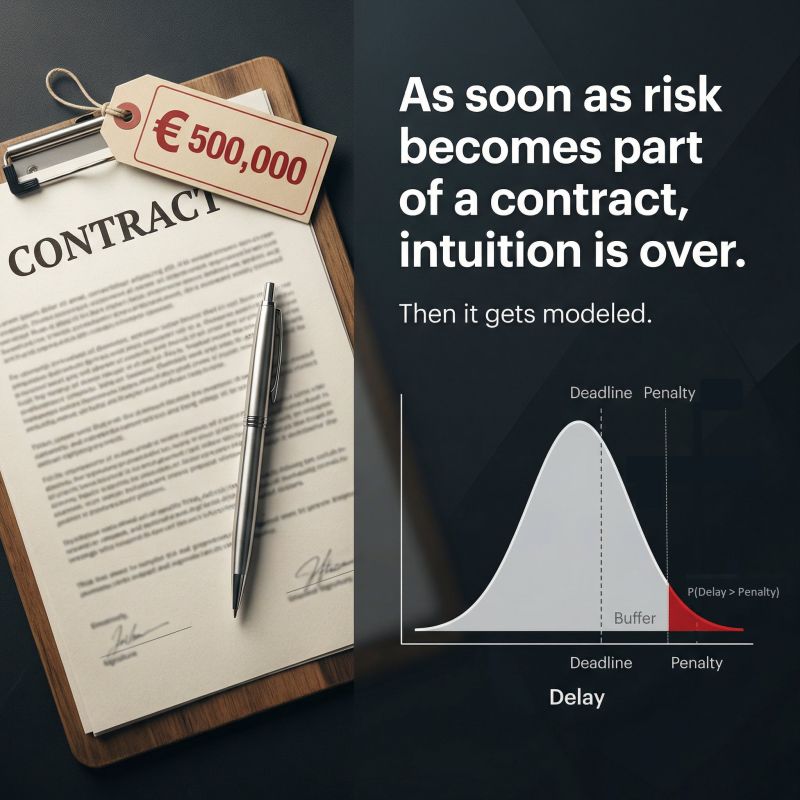
“The senior engineer believes it will hold.” Nobody would accept this sentence today, at least not in product development. There, things are measured, calculated, simulated. Load curves, tolerances, failure probabilities. Why? Because mistakes cost money immediately. Interestingly, companies accept this exact sentence in risk management: 👉 The risk owner believes that this is the worst case. 👉 The expert estimates that it should be fine. This is considered appropriate practice. The difference is not only methodological, but above all economic. Wherever uncertainty gets a price tag, models emerge (even without regulatory pressure): • in product development • in large projects (delivery dates, penalties, warranties) • in banks and insurance companies Why? Because one percent more risk there translates directly into money. My favorite rule of thumb on this: Once risk becomes part of a contract, gut feeling is over. This also explains why internal Enterprise Risk Management often gets stuck at expert assessments. The consequences are diffuse. Losses occur with a delay and can hardly be attributed. Responsibility is spread across many shoulders. So opinions survive. Not because they are better, but because they are more convenient. Quantitative risk models do not replace experts. They cast expertise into explicit structures: • risk drivers from the real world • interactions and dependencies between the risk drivers • effects on target variables And suddenly risk becomes transparent and manageable. Perhaps that is the most important insight: Quantitative risk models are affordable and powerful today. Skeptics are nonetheless often only convinced once wrong assessments immediately cost money and can be directly attributed to whoever caused them. If you would like to see how such considerations translate into concrete, practical risk models, we are happy to show you, among other things with Risk Kit and the Enterprise Risk Evaluator. Feel free to write to me.
This post was originally published on LinkedIn. View and join the discussion there