
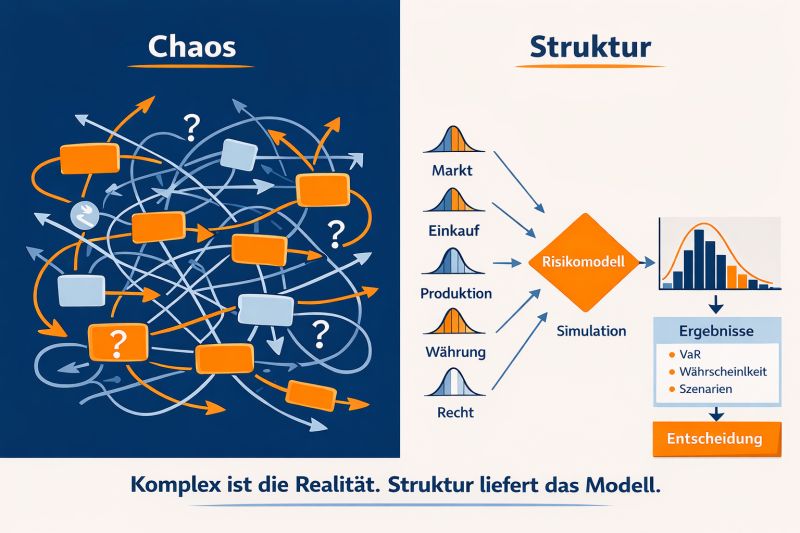
“That is too complex.” This is the most common objection to quantitative risk management. And it is entirely understandable. Because behind this sentence there is usually more than a methodological critique. Behind it is: • fear of mathematics • fear of being overwhelmed • fear of having to explain things • fear of having to stand behind a model Whoever works quantitatively becomes the “owner” of the method. You choose distributions. You define parameters. You structure the model. You have to explain it and defend it. That commands respect. And that is normal. But here is the crucial point: The complexity does not come from the method. It comes from the world itself. When I structure a business model cleanly, identify risks, and make dependencies visible, I have already done most of the work, even before I calculate anything at all. Complex means: • Several factors act at the same time. • They influence each other. • They overlap. That is reality. Not mathematics. The model merely says: “Yes, that is exactly how it is. We accept this complexity, and we make it transparent.” The Monte Carlo simulation is then not a driver of complexity, but a tool for evaluation. It calculates what is structurally there anyway. And now comes the second, often overlooked point: The approach itself is always the same. A quantitative risk model is built following a generic pattern: 1. Structure 2. Define uncertainties 3. Model relationships 4. Run the simulation 5. Derive decision relevance This process model is universal. It stays the same regardless of the subject matter. The evaluation, too, always follows the same logic: • probabilities of critical developments • risk measures (e.g., Value at Risk) • sensitivities • histograms • distribution functions • loss exceedance functions The building blocks are standardized. The framework is stable. A quantitative model is therefore exactly as complex as the underlying subject matter, but not more complicated. And one more thing: You only do the development work once. You only have to bring the child into the world once. After that, it exists. A well-built model is not reinvented every year. It continues to be used, adjusted where needed, and further developed. And at some point, the process becomes routine. Quantitative risk management does not mean creating additional complexity. It means acknowledging existing complexity and making it systematically manageable. That is where its strength lies.
This post was originally published on LinkedIn. View and join the discussion there