
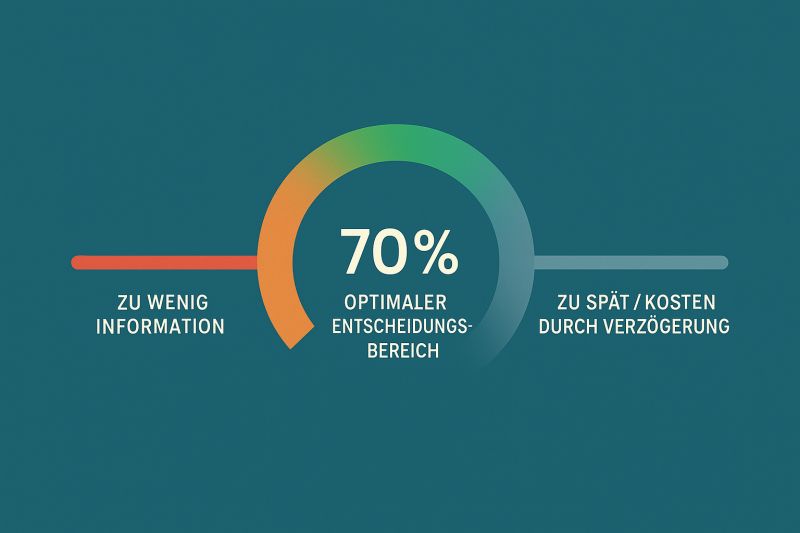
“As an entrepreneur, you should make most decisions with 70% of the information you wish you had. If you wait for 90%, you're usually too slow.” Jeff Bezos Many companies know this dilemma: whoever waits for complete certainty loses valuable time. And in competition, time is often the biggest cost factor. This leads to a central question: How do you make fast decisions without acting with gross negligence? This is exactly where the real task of risk management begins. Risk management makes uncertainty fit for decisions. At the moment of decision, its task is to: • make options visible • quantify relevant uncertainties • test the robustness of alternatives • realistically estimate consequences This creates a framework in which decision makers can act quickly even with 70% of the information, without being negligent. Negligence arises not only from wrong decisions but just as much from not deciding at all. Bezos is not talking about speed for its own sake, but about the cost of hesitation: • missed opportunities • missed market windows • escalations that could have been caught early • strategies adjusted too late Many of these losses occur because uncertainty was never translated into a format that supports action. The real achievement of good risk management lies exactly here: it turns uncertainty into information that decision makers can work with: • scenarios instead of gut feeling • probabilities instead of hunches • consequences instead of guesswork • options instead of dead ends In short: risk management creates the conditions for a company to stay able to act under uncertainty: quickly, prudently, and without negligence.
This post was originally published on LinkedIn. View and join the discussion there